

Baccarat is one of the most straightforward table games in the casino, despite its reputation for high-stakes glamour and exclusivity. It’s easy to learn, quick to play, and offers some of the best odds of any casino game. This guide is designed for someone who has never played baccarat before and wants a clear, simple explanation of how the game works from start to finish.
The Objective of Baccarat
The game of baccarat is played between two hands: the player and the banker. These don’t refer to the person playing and the casino dealer, but rather to the two sides that receive cards during the game. Your role is simply to bet on which hand you think will win, or whether the result will be a tie. The hand that ends with a total closest to nine is the winner.
Baccarat is usually played with six or eight standard decks of cards shuffled together. The table has a layout with marked areas where players place their chips to bet on the player, banker, or a tie. You do not receive your own cards or make decisions during play. Once bets are placed, the dealer handles everything else, and the outcome is determined by the rules of the game.
Card Values and Hand Totals
The value of each card in baccarat is very simple:
- Cards from 2 to 9 are worth their face value
- 10s, Jacks, Queens and Kings are worth zero
- Aces are worth one
Only the last digit of a hand’s total counts. If a hand adds up to 15, its value is 5. If it totals 23, the value is 3. For example, a hand with a 7 and a 9 equals 16, which means the hand is worth 6.
How the Game is Played
At the start of each round, two cards are dealt to the player hand and two to the banker hand. If either hand has a total of 8 or 9, this is called a natural and no more cards are drawn. If neither hand has a natural, a third card may be drawn depending on specific rules.
The rules for drawing a third card are automatic and determined by the totals of the first two cards. If the player hand totals between 0 and 5, it will draw a third card. If the player has 6 or 7, it stands. The banker’s third card rule is slightly more complicated, as it depends on both the banker’s total and whether the player drew a third card.
When the Banker Draws a Third Card
Here is a simplified summary of when the banker draws a third card:
- If the banker has 0, 1 or 2, a third card is always drawn
- If the banker has 3, it draws unless the player’s third card is an 8
- If the banker has 4, it draws if the player’s third card is 2 through 7
- If the banker has 5, it draws if the player’s third card is 4 through 7
- If the banker has 6, it draws if the player’s third card is 6 or 7
- If the banker has 7, it stands
These rules are applied automatically by the dealer or game software, so you don’t need to memorise them to play. Once all cards are drawn, the hand with the total closest to nine wins. If you bet on the winning hand, your bet is paid out accordingly.
The Three Main Bets
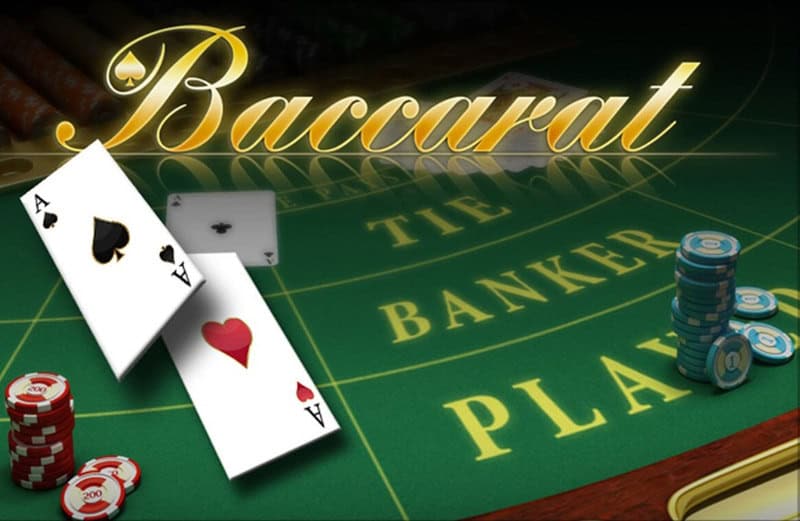
There are three main betting options in baccarat: betting on the player hand, betting on the banker hand, or betting on a tie. The player bet pays 1 to 1. The banker bet also pays 1 to 1, but most casinos take a 5% commission on banker wins because this bet has a slightly higher chance of winning. The tie bet usually pays 8 to 1 or sometimes 9 to 1, but it is much less likely to win and has a higher house edge.
Payouts and House Edge
The table below shows the typical payouts and house edges:
| Bet Type | Payout | House Edge |
|---|---|---|
| Player | 1:1 | 1.24% |
| Banker | 1:1 (with 5% commission) | 1.06% |
| Tie | 8:1 (or 9:1) | 14.36% |
Optional Side Bets
Although these are the core bets, many casinos also offer optional side bets. These can vary between different venues and software providers, but they often include bets like the player or banker receiving a pair, either hand receiving a suited pair (called a perfect pair), or how many cards will be used in the round. These side bets usually offer higher payouts but have a much higher house edge, so they’re best approached as a bit of fun rather than a serious part of your strategy.
Baccarat Etiquette and Table Variations
Baccarat is sometimes seen as a high-roller game, but it’s actually very accessible. Many online casinos offer baccarat tables with low minimum bets, and there is no skill required to play – the outcome is entirely based on the cards. Your only decision is what to bet on each round. This makes baccarat a good choice for beginners or for players who want a low-stress game without complicated rules or fast decisions.
When playing at a land-based casino, baccarat etiquette is very simple. You place your chips in the marked betting area and let the dealer handle the cards. Players do not touch the cards in most versions of the game. At mini-baccarat tables, which are more common in casual casino settings, the game is exactly the same, but the dealer runs everything and the pace is faster.
Game Variants
You may also encounter different versions of the game. Punto Banco is the most common form of baccarat in the UK and in online casinos. Chemin de Fer and Baccarat Banque are European versions where players may take a more active role, including dealing or acting as the banker, but these are rare in public casinos today. For most players, Punto Banco is the standard, and it is the version this guide has focused on.
Final Thoughts
To get started, simply choose a table, decide how much you want to bet, and place your chips on the player, banker, or tie. Once the cards are dealt, the game plays out automatically. You don’t need to understand or remember the third-card drawing rules in order to enjoy the game.
Baccarat is ideal for players who want an elegant, simple, and low-decision game with a good chance of winning. If you stick with banker or player bets and avoid the tie and side bets, you’ll be playing one of the lowest-house-edge games in the casino. It’s a great place to start if you’re new to table games, and once you’ve played a few rounds, you’ll find the rhythm of the game becomes second nature.